
According to government statistics, the disposable annual income of people aged below 30 averaged only NT$366,000 (US$12,388) in 2012, lower than NT$380,000 in 1999.This wealth gap between generations, as this Commercial Times points out, is cushioning the blow this brutal economy is giving the young. Meanwhile the KMT continues to serve the big money -- still no real stock tax, no change in the land tax (here), and now the premier wants to chain the minimum wage to the consumer price index (CPI), essentially freezing it at the current low level for the next few years:
In 2012, the starting monthly salaries for bachelor's degree holders averaged NT$26,000, down from NT$28,000 in 1999. The average starting salary of master's degree holders was NT$31,000, up only slightly from 13 years ago, when the average salary was NT$30,000.
There is an obvious trend in which wealth is concentrated in the hands of the older generations.
In 2010, 75 percent of residential properties in Taiwan were owned by people aged 45 or older, with homeowners younger than 35 accounting for only 8 percent. Many of these young homeowners are believed to have obtained financial support from their parents. In other words, the situation for young people is even worse than it appears.
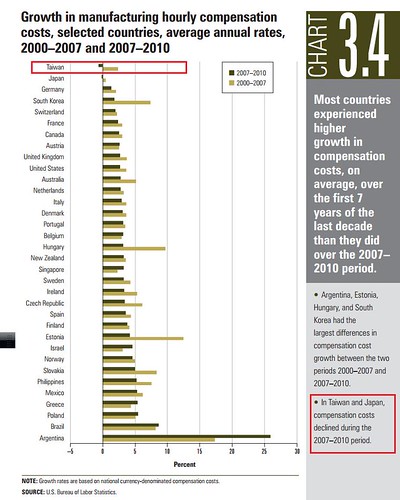
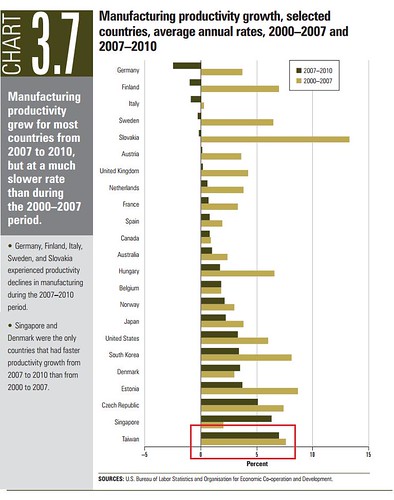
Premier Jiang Yi-huah (江宜樺) yesterday decided that beginning next year, the minimum wage will be contingent on growth in the consumer price index (CPI), a policy drawing severe criticism from labor groups.This means that the government can hold wages down without appearing to, simply by lowballing the CPI. Theoretically, wages will always remain the same relative to prices, which means that laborers will never be able to capture a larger share of the pie, at least while the Ma government is in office. Since 2007 and especially since the Ma Administration came to power, wages have regressed while productivity has boomed. Taiwan's gap between CPI changes and wage changes was the highest in the world in 2010. The Ma government wants to freeze this historically anomalous situation and treat it as the norm. The struggle for control of Taiwan between the pro-China and pro-Taiwan sides really masks the brutal and ongoing defeat of Taiwanese workers economically; it enables both parties to enlist workers on their side via their tribal social identities while screwing them out of their rightful livelihood.
With a threshold of a cumulative CPI growth of 3 percent or higher needed before the minimum wage will be reviewed, “it is highly likely that the basic wage levels will remain stagnant in the remaining three years of President Ma Ying-jeou (馬英九) tenure,” Taiwan Labor Front secretary-general Son Yu-lian (孫友聯) said.
_______________________
[Taiwan] Don't miss the comments below! And check out my blog and its sidebars for events, links to previous posts and picture posts, and scores of links to other Taiwan blogs and forums!


No comments:
Post a Comment